
Regarding biophysical research, our plan is to establish a network of headwater catchments. The majority of these catchments (10) will be situated on siliceous lithologies, while a few (3) will be on carbonaceous bedrock. These catchments will span the entire latitudinal range, starting from the boreal subarctic area in Northern Europe and extending to mountains in Central and Southern Europe. This geographical distribution enables us to cover the complete climate and N-P deposition gradients across Europe.
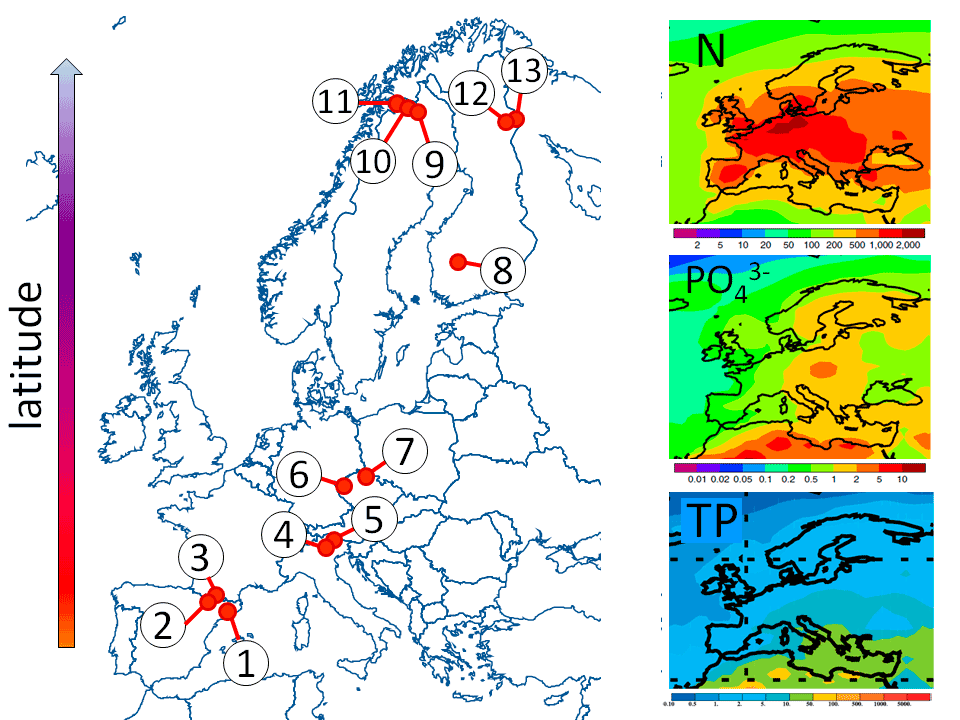
Location of the study catchments and maps of modeled N-P deposition. 1) Fuirosos (ES), 2) Barranc del Orris (ES) 3) Contraix (ES); 4) Focobon (IT); 5) Valfredda (IT); 6) Lysina (CZ); 7) Uhlirska (CZ) 8) Hyytiälä (FI) 9) Stordalen (SE) 10) Kuokkel (SE) 11) Riksgränsen (SE); 12) Yli-Nuortti (FI); 13) Kotkakurunoja (FI). Right column: Maps of modeled reactive nitrogen (N), phosphate (PO43-) and total phosphorus (TP) deposition over Europe1,2. Units are mg m-2 yr-1.
In most of the catchments included in our study, ongoing monitoring programs have been established, resulting in datasets spanning from one to four decades. In the SERVICO2 project, we will conduct a re-analysis of the existing data in the Work Package 2 (WP2), as well as data from other existing public databases such as ICP-Waters, Long-Term Ecological Research (LTER) and Integrated Carbon Observation System (ICOS) for instance, to identify trends and relate water quality to the C cycling aspects, including emission of GHGs. We will apply a combination of meta-analysis, statistical modelling, and process modelling, with a final synthesis of all the data. WP2 consists of six tasks:
Task 2.1: Database design, data collation:
We will develop a database to collect time series (e.g., automated sensors), discrete sampling data (e.g., grab samples for water chemistry), and metadata (e.g., catchment properties). The database will be implemented in Kaivos, the database service offered by the Finnish IT Center for Science (CSC; kaivos.csc.fi).
Task 2.2 Estimates and trends in weathering rates:
We will estimate the weathering rate for each catchment based on watershed geochemical mass balance3,4. Most of the literature of weathering rates focus on short-term comparative studies between catchments5,6. Long-term monitoring data from our sites, reaching back up to 42 years, will allow us to pioneer a study of weathering over time. We will further leverage our results by including additional datasets from long-term monitoring.
Task 2.3 Estimates and trends in export of carbon and greenhouse gases:
We will re-analyse the annual export of C (dissolved and particulate organic and inorganic C) and GHGs along with stream discharge. Our analysis will further assess how the POC, DOC and DIC discharge of each catchment changed over time, the degree by which these changes can be attributed to changes in temperature and precipitation, and how these climate impacts are modulated by landscape properties.
Task 2.4 Estimates and trends of GHG vertical fluxes, respiration, and primary production:
We will re-analyse existing datasets of soil, vegetation, and water GHG exchange available in the study catchments using both statistical and process-based models. In the initial project phase, we will identify key uncertainties, data gaps, and the additional measurements needed to improve the model estimates.
Task 2.5 Estimates and trends in water quality including nutrients:
We will focus on the nutrients in precipitation and running waters. With the data of the precipitation, we will assess the European N-P deposition maps1,2. The running waters are integrators of the trophic status at the catchment level, by measuring them we will evaluate the suggested recovery from past eutrophication whose causes are uncertain; could be due to the recent decrease in N deposition7 or due to other Global Change effects8,9.
Task 2.6 Modeling and Synthesis:
We will use random forest models to upscale GHG fluxes from the different landscape units to the whole catchment scale. The target variables will be the areal fluxes of CO2, CH4 and N2O obtained both from the re-analysis or from direct determinations. We will analyse these data to identify spatio-temporal trends associated with climate, N-P deposition, and land-use changes. Furthermore, we will evaluate these results by reviewing them from the perspective of the ES identified in WP1.
1 Mahowald, N. et al. Global distribution of atmospheric phosphorus sources, concentrations and deposition rates, and anthropogenic impacts. Global Biogeochem. Cycles 22, GB4026, doi:10.1029/2008gb003240 (2008).
2 Peñuelas, J. et al. Human-induced nitrogen-phosphorus imbalances alter natural and managed ecosystems across the globe. Nature Communications 4, 2934, doi:10.1038/ncomms3934 (2013).
3 Velbel, M. A. & Price, J. R. Solute geochemical mass-balances and mineral weathering rates in small watersheds: Methodology, recent advances, and future directions. Applied Geochemistry 22, 1682-1700 (2007).
4 Krám, P., Hruška, J., Wenner, B. S., Discoll, C. T. & Johnson, C. E. The biogeochemistry of basic cations in two forest catchments with contrasting lithology in the Czech Republic. Biogeochemistry 37, 173-202, doi:10.1023/a:1005742418304 (1997).
5 Oliva, P., Viers, J. & Dupré, B. Chemical weathering in granitic environments. Chemical Geology 202, 225-256, doi:https://doi.org/10.1016/j.chemgeo.2002.08.001 (2003).
6 White, A. F. & Blum, A. E. Effects of climate on chemical weathering in watersheds. Geochimica et Cosmochimica Acta 59, 1729-1747 (1995).
7 Schmitz, A. et al. Responses of forest ecosystems in Europe to decreasing nitrogen deposition. Environmental Pollution 244, 980-994, doi:https://doi.org/10.1016/j.envpol.2018.09.101 (2019).
8 Groffman, P. M. et al. Nitrogen oligotrophication in northern hardwood forests. Biogeochemistry 141, 523-539, doi:10.1007/s10533-018-0445-y (2018).
9 Mason, R. E. et al. Evidence, causes, and consequences of declining nitrogen availability in terrestrial ecosystems. Science 376, eabh3767 (2022).