The day began with presentations by researchers from UEF, LUKE and UHEL, highlighting aquatic and fish research conducted in the upper reaches of the Kemijoki River, as well as climate and zoological research carried out at the Värriö Research Station of UHEL. The participants were also introduced to SERVICO2 and its objectives.
The stakeholders included representatives of the Municipality of Savukoski, regional authorities and NGOs, among others. They showed great interest in the research conducted in the region, with discussions beginning during and between the presentations and continuing throughout the afternoon.
In the afternoon, participants were introduced to the Nature Futures Framework and invited to explore what they would like the future of the Upper Kemi River catchment to look like. The co-creation session began with a short survey designed to capture participants’ perceptions of the ecosystem services provided by headwater catchments in the context of SERVICO2.
The discussions revealed strong concerns about how local interests are represented in national decision-making and about the intensive exploitation of the region’s natural resources. Savukoski was described as one of the last relatively unspoiled areas in Europe, and participants expressed a desire to find alternative development pathways that could preserve its natural environment while supporting the local community. Sustainable tourism emerged as one possible future, offering opportunities for economic development while maintaining the wilderness character of the region.
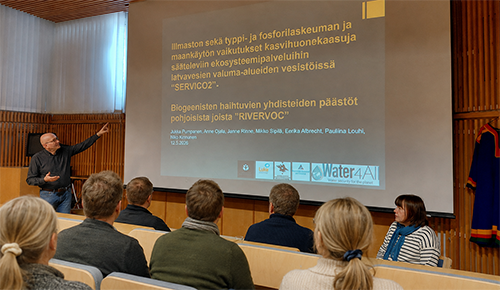
Prof. Jukka Pumpanen (UEF) and Dr. Anne Ojala during Pumpanen’s presentation about SERVICO2 and RIVERVOC projects.
The future of migratory fish
The most extensively discussed issue was the future of migratory fish in the Kemijoki River. Fish stocks have been severely reduced over decades, particularly as a result of hydroelectric power production. Participants expressed a strong desire to restore migratory fish populations by improving wintering and breeding habitats, which have been affected, among other factors, by humus loads from forested areas. Restoring these habitats could help ensure that reintroduced fish populations become established and remain in the region.
The possibility of developing local fish-rearing facilities was also discussed as an alternative to relying on fish raised in facilities located in the lower Kemijoki. Another vision for the future involved the introduction of fish bypass channels around hydroelectric dams, allowing migratory fish to move more freely along the river. Such solutions have already been implemented in several European rivers and at some Finnish hydropower facilities, although they are not yet standard practice.
For some participants, the desired future was also closely connected to the past: they remembered a time when fish populations were much healthier and hoped that future restoration efforts could bring the river closer to those earlier conditions.
Looking ahead
The event concluded with a shared interest in seeing more research on water quality and fish populations in the region. The discussions in Savukoski demonstrated the value of bringing local knowledge, experiences and aspirations into the SERVICO2 research process.
The upcoming co-creation workshops in the other SERVICO2 countries will provide opportunities for stakeholders in different European headwater catchments to share their perspectives, identify common challenges and explore different visions for the future of these important ecosystems.